A small rock in the Atlantic

All about the island of La Palma, in the Canaries.

Click for La Palma, Canary Islands Forecast

Saturday, 13 March 2010

The Octopus's Funeral, Los Cancajos

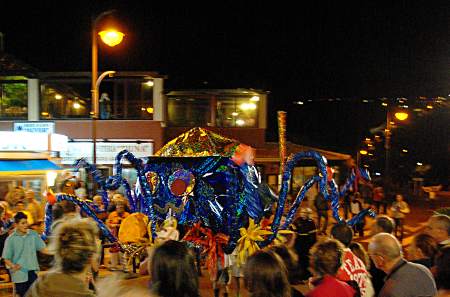
The octopus's funeral procession, Los Cancajos, Breña Baja, La PalmaThe octopus's funeral procession

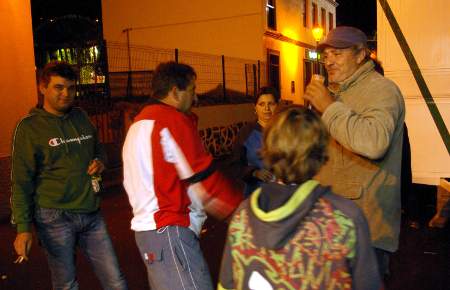
Most places in Spain end Carnival with a mock funeral for a sardine. Los Cancajos decided to have a few carnival events this year, ending in an Octopus's funeral (just for a change).
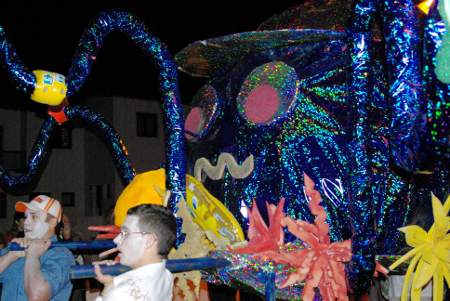
Close up of the octopus, Los Cancajos, Breña Baja, La PalmaClose up of the octopus

But the weather was terrible, and they postponed it for two weeks. And when the new date came around, there weather was terrible again, and they had to postpone it again!

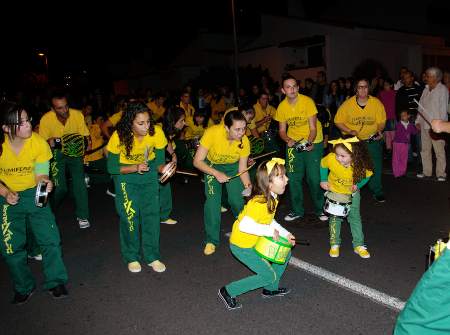
The percussion band for the Octopus's Funeral, Los Cancajos, Breña Baja, La PalmaThe percussion band

Third time lucky - the funeral went ahead last night. A percussion band (a batucada) provided the music.

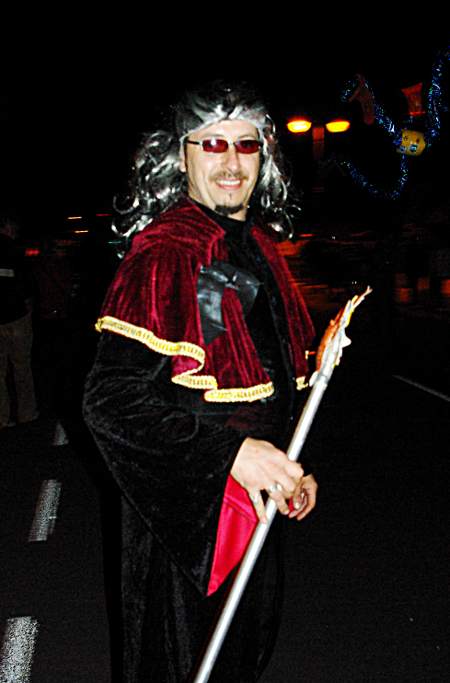
The Master of Ceremonies for the octopus's funeral, Los Cancajos, Breña Baja, La PalmaThe Master of Ceremonies

The master of ceremonies, looked rather fine as he led the way, keeping the octopus and band together.
The octopus's cremation, Los Cancajos, Breña Baja, La Palma

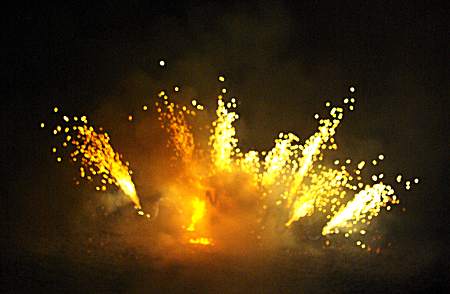
The procession went through the village and down to the beach, where they cremated it and let off the fireworks.


Fireworks at the octopus's funeral, Los Cancajos, Breña Baja, La Palma


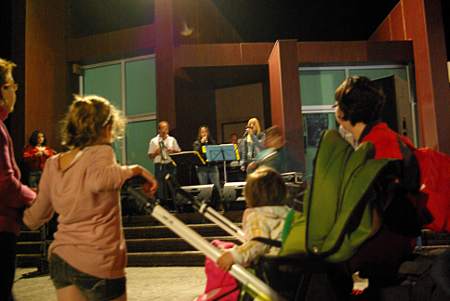
We left, just as the band was starting up for the public dance. It was great fun, and I'm sure they'll do it again next year.

The band for the octopus's funeral, Los Cancajos, Breña Baja, La PalmaThe band

Labels: , , , ,

Bookmark with:

Del.icio.us Digg Reddit Facebook Furl It Newsvine StumbleUpon ToolbarStumbleUpon

Tuesday, 9 March 2010

Fiestas in Breña Baja


Los Cancajos
They'll be having yet another attempt to cremate the octopus in Los Cancajos on Friday 12th, starting at 8pm. This was supposed to happen during Carnival, but it's been postponed twice due to bad weather. The town hall assures everyone that the octopus won't have gone smelly, because it's been frozen during the wait.
[This is a joke. I'm sure it isn't a real octopus.]
Anyway, the procession will leave at 8 pm from the chemist's near the south end of the village.

San José
Spain celebrates Father's Day on March 19th, because that's St Joseph's day. Since the Spanish for St Joseph is San José, the village of San José will hold fiestas, starting on Friday 12th at 5 pm. There will be various sporting events and talks, an exhibition of oil paintings which opens on Monday evening, and films (in Spanish) . There'll be a special mass on Friday evening (the 19th) and on Saturday there's a hike, bouncy castles and a horse race. In the evening, there's batucada (serious percussion) a stage performance by the kids, and a disco.
Labels: , , , , ,

Bookmark with:

Del.icio.us Digg Reddit Facebook Furl It Newsvine StumbleUpon ToolbarStumbleUpon

Thursday, 4 March 2010

Tazacorte Church

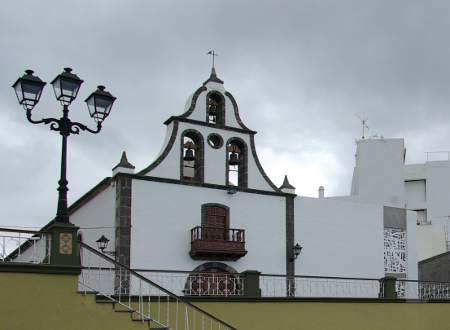
The outside of the church of St Michael the Archangel, TazacorteThe outside of the church of St Michael the Archangel, Tazacorte

On Thursday I was in Tazacorte, so I popped into the church. I'm not religious, but most of the churches on La Palma are beautiful, and worth at least a quick look. Even if the building itself isn't special, there's often a beautiful renaissance statue. In this case, I'd recently translated a text that said the church "was built at the end of the 15th century, making it the oldest religious building on the island. It has been restored, enlarged and altered on several occasions."


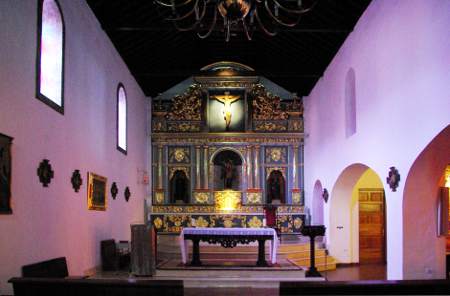
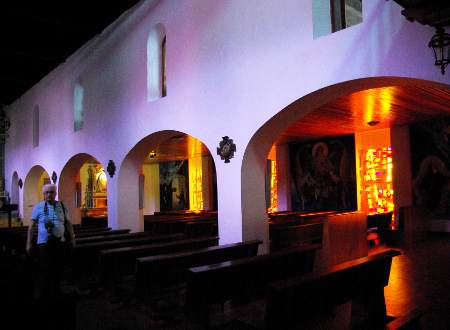
The old nave in Tazacorte churchThe old nave in Tazacorte church

Sure enough, this nave is very like most of the old churches on La Palma, with whitewashed walls, semi-circular arches, and a lovely coffered ceiling and baroque altar-piece.

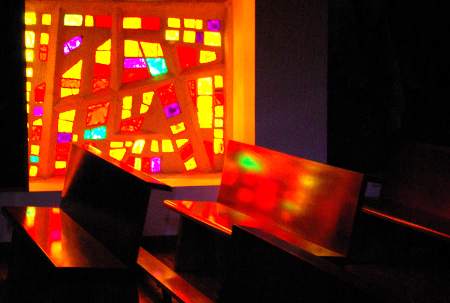
The new nave of Tazacorte churchThe new nave of Tazacorte church

And this is the other nave! They weren't kidding about " restored, enlarged and altered" were they? I haven't been able to find out a definite date, but the style looks like the 1960s or 1970s.

The amazing thing is that the combination looks great. The architect must be a genius. I'm sure that if I tried to put a 1960s nave next to a 1490s nave, the result would be a right dog's breakfast.

Standing in the old nave of Tazacorte church, looking towards the new naveStanding in the old nave of Tazacorte church, looking towards the new nave.


So I tried to work out why the two very different nave look as though they belong to each other. Well, they both have white-washed walls, and the same floor and pews. They're joined by semi-circular archways, which are common in the old churches here. Both have wooden ceilings, although the new one is lower, lighter, and simpler. So I sort-of see why it works. but I still say the architect is a genius.

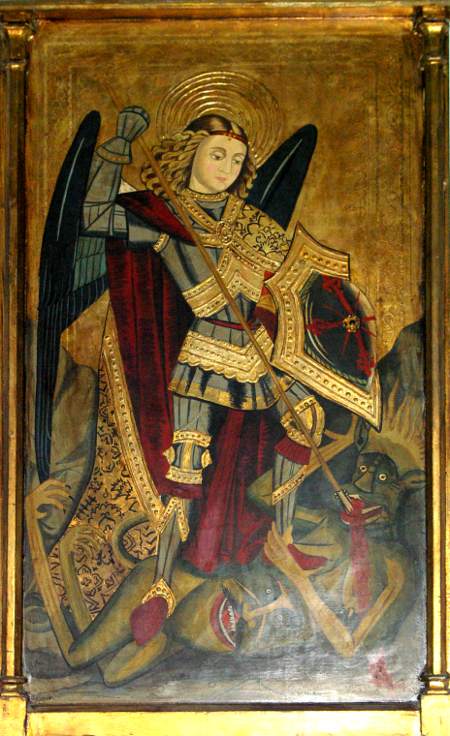
And yes, there's a very old painting of St Michael the Archangel defeating the devil.

Old painting of St Michael in Tazacorte churchOld painting of St Michael in Tazacorte church

Labels: , , ,

Bookmark with:

Del.icio.us Digg Reddit Facebook Furl It Newsvine StumbleUpon ToolbarStumbleUpon

Wednesday, 3 March 2010

Divine Biscuits from the Cistercian Convent
The Cistercian convent at Buenavista in Breña Alta, La PalmaThe Cistercian convent at Buenavista in Breña Alta, La Palma

The Cistercian convent of the Holy Trinity at Buenavista in Breña Alta is surprisingly new. It was founded in 1946, and it's the only closed order on the island. I was surprised to find out that there are only ten nuns who live there.

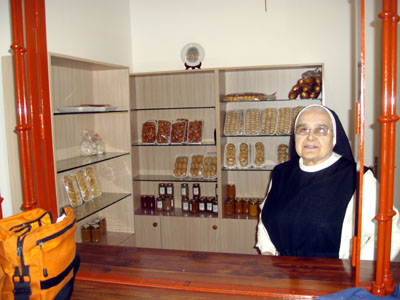
The convent has a small shop. I first went there about eleven years ago, in search of a rosary made of dragon-tree seeds, for a Catholic friend who was losing her eyesight. The seeds are big enough that you can feel your way through the prayers, and she was delighted. At the time, the shop was still in the older part of the building, and to my eyes, very exotic. The room was rather dark, and seemed darker because of the wooden paneling. The nun who came to serve me stayed behind a tiny barred window, as though she were in jail - until she saw that I had a toddler with me. Then she disappeared, and came round to my side for a good coochi-coo.
A Cistercian nun in the convent's shop, Breña Alta, La PalmaA nun in the convent shop

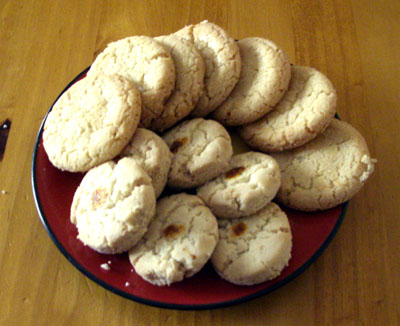
The new shop is much airier, as you can see. They still sell rosaries and religious medals, but they're best known for their biscuits, pastries and fruit liquors. Since they're handmade, they're a bit on the expensive side (these were €4.50), but they're delicious. My mother-in-law always used to say, "God knows what they put in them, but they taste divine."

Biscuits from the convent at Buenavista in Breña Alta, La PalmaBiscuits from the convent at Buenavista in Breña Alta, La Palma

Labels: , , , , ,

Bookmark with:

Del.icio.us Digg Reddit Facebook Furl It Newsvine StumbleUpon ToolbarStumbleUpon

Friday, 26 February 2010

I Don't Believe It!

(said in my best Victor Meldrew impersonation.)

We're on orange alert again, because there's yet another storm headed our way.

This one is small and intense and due to hit tonight with wind gusts up to 160 km/h on the peaks and possible heavy rain. The only good bit is that it's zipping along so fast that it should be over by lunchtime Saturday.

The observatory has been evacuated, the Octopus's funeral tonight has been postponed again, along with the hiking club's coast-to-coast walk on Saturday.

I haven't heard anything definite about the Sardine's Funeral on Saturday in Los Sauces. The storm may well have gone by then.

Labels: , , , ,

Bookmark with:

Del.icio.us Digg Reddit Facebook Furl It Newsvine StumbleUpon ToolbarStumbleUpon

Tuesday, 23 February 2010

An Octupus and a Sardine

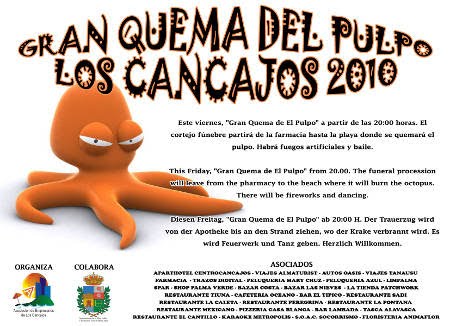
Poster for the Octopus's Funeral, Los Cancajos, La Palma Island
The Octopus's funeral has been rescheduled for Friday 26th.

The procession will leave the pharmacy at 8 pm and make its way to the beach, where the octopus will be cremated. There will be fireworks and dancing. Everybody welcome.
This is a new fiesta, so it'll be interesting to see

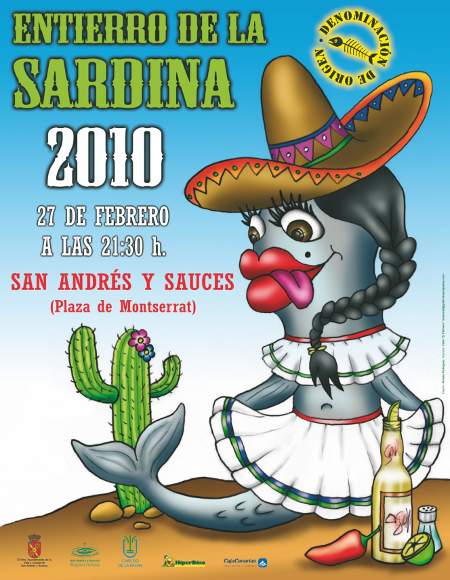
Meanwhile the sardine's funeral at Los Sauces will take place on Saturday 27th. The percussion music starts at 8 pm and the funeral procession starts at 9:30 pm in the main square by the church. Last time I saw it, it was wonderful.

And I believe that Barlovento will hold their sardine's funeral the weekend after, on March 5th or 6th. Watch this space.

Poster for the Sardine's Funeral, Los Sauces, La PAlma island

Labels: , , , , , , ,

Bookmark with:

Del.icio.us Digg Reddit Facebook Furl It Newsvine StumbleUpon ToolbarStumbleUpon

Sunday, 21 February 2010

North Road Closing

We've had major roadworks in the north of the island for some time, with some places reduced to one lane, so that you have to wait for traffic lights. Now they'll be closing the road completely at km 24, just north of Los Sauces, twice a day.

The road will be closed Monday - Friday 9:30 am - 12:30 am and 4 pm - 7 pm.

Labels: , , ,

Bookmark with:

Del.icio.us Digg Reddit Facebook Furl It Newsvine StumbleUpon ToolbarStumbleUpon

Thursday, 18 February 2010

Weather Forecast

Well the storm's gone, thank goodness, but there's more rain due on Saturday and Sunday. Enjoy Friday, quick!

We've had a lot more bad weather than usual this winter.

On a happier note, there's a children's carnival party at La Polvacera Sports Ground, with dancing, games, art workshops and murgas. Come in fancy dress if you can, at 5 pm.

Children's Carnival party, La Polvacera, Breña Baja, La Palma

Labels: , , ,

Bookmark with:

Del.icio.us Digg Reddit Facebook Furl It Newsvine StumbleUpon ToolbarStumbleUpon

Tuesday, 16 February 2010

La Palma Carnival: Tuesday - Friday

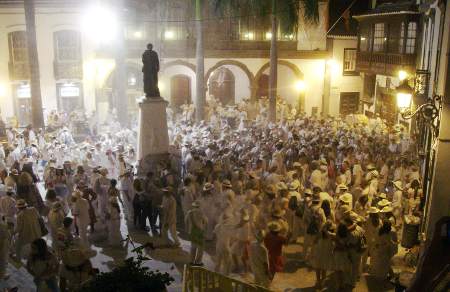
Fiesta de los indianos (powder night) santa cruz de la PalmaLos Indianos, Santa Cruz de la Palma

Tuesday 16th
Santa Cruz de la Palma
5 pm Fancy dress ball in the senior citizens day centre, with live salsa music

Los Llanos
Cancelled

Wednesday 17th
Santa Cruz de la Palma
11 am Presentation of prizes in the town hall.

Los Llanos
11 am - 1 pm Children's activities, Plaza de España
8 pm Murgas, Plaza de España

Cancajos
8 pm the Octopus's Funeral followed by a dance


Thursday 18th

Los Llanos
7 pm Comparsas (musical groups) at the carnival stage
8 pm Murgas, Plaza de España

Friday 19th
Santa Cruz de la Palma
9 pm The Sardine's funeral. Procession from the Alameda to the carnival stage, followed by the cremation, fireworks and a dance.

Los Llanos
11 am - 1 pm Children's activities, Plaza de España
1 pm The Sardine's funeral starts at El Camino Los Lomos -Los Pedregales. At 7 pm the procession leaves for La Calle Ramón Pol. and should arrive a 9:30 pm. On it's arrival, the sardine will be cremated.
10 pm Live music at the carnival stage
The Sardine's funeral, santa cruz de la palma

Labels: , , , ,

Bookmark with:

Del.icio.us Digg Reddit Facebook Furl It Newsvine StumbleUpon ToolbarStumbleUpon

Monday, 8 February 2010

Puntagorda's Almond Blossom Fiesta

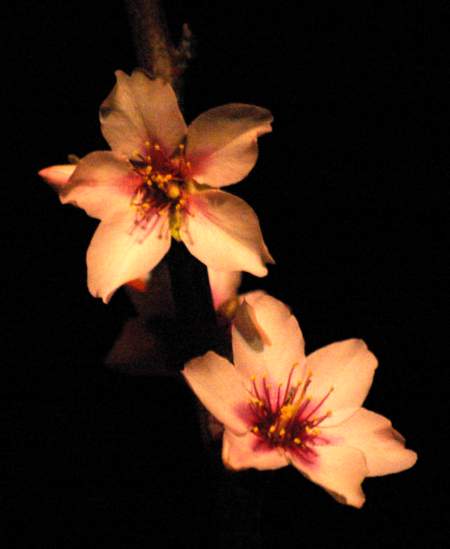
Puntagorda fiesta: almond blossomPuntagorda fiesta: almond blossom

La Palma isn't a big island, but it still takes almost 2 hours to drive from Breña Baja to Puntagorda. I found most of the blossom had been spoiled by the bad weather last week, but it was still pretty. (In a good year, the whole hillside turns pink.) Then I got sidetracked into visiting a friend's barbecue, and very nice, too. I finally got to the main fiesta just as they were packing up, at 10 pm. This is amazingly early for a Canarian fiesta, but they danced half the night on Saturday, and they all had to get up on Monday morning.

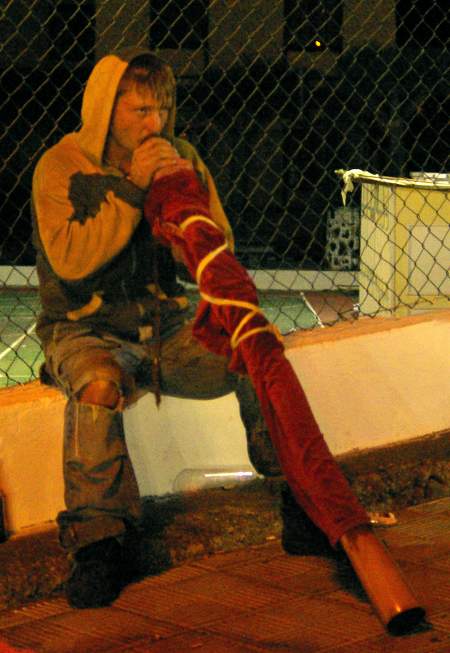
Puntagorda fiesta: Hippy playing a didgeridooPuntagorda fiesta: Hippy playing a didgeridoo

A lot of German hippies live in and around Puntagorda, and they seem to get on very well with the locals. Here's one playing the didgeridoo at the end of the fiesta.

Puntagorda fiesta: the debrisPuntagorda fiesta: the debris

You can see that people had a good time! One of the locals was embarrassed to see my photographing this, but I don't like rooms that are so tidy you're scared to sit down, and I think villages are supposed to get messy when they've had a good party. Besides, the street cleaners were already hard at work, and I expect it'll all be clean and tidy by the time I post this.

Puntagorda fiesta, La Palma: The last bar openPuntagorda fiesta: The last bar open

Even though the band had left, and most of the stalls were packing up, a few people still gathered round the last open bar. As usual, people were merry, but nobody was outright drunk, and nobody was annoying. In fact I got two offers of bed and breakfast, but neither gentleman took offence when I said that, sorry, I was going home to my husband.

Puntagorda fiesta: the last few revelersPuntagorda fiesta: the last few revelers

Labels: , , , ,

Bookmark with:

Del.icio.us Digg Reddit Facebook Furl It Newsvine StumbleUpon ToolbarStumbleUpon

Thursday, 4 February 2010

Breña Baja: The Old Butcher's Shop

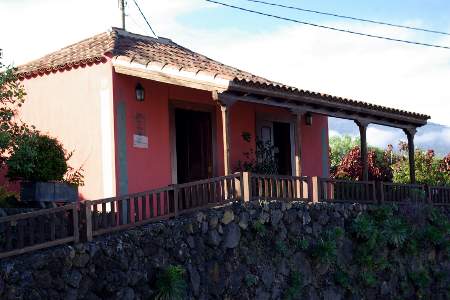
The 19th century butcher's shop, Breña Baja, La PalmaThe 19th century butcher's shop, Breña Baja, La Palma

The old butcher's shop stands on the outskirts of the village of San Jose, in Breña Baja, near the Paradorof La Palma. The building dates from the late 19th century, and it was a butcher's shop until the 1960s. But now it's been renovated as a craft exhibition and shop.

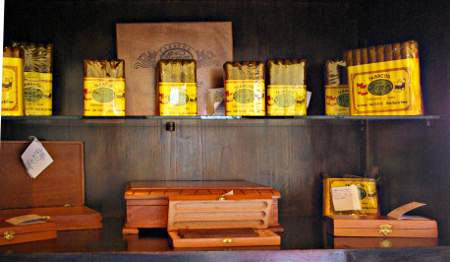
The famous cigars of the Breñas San Jose de Breña Baja, La PalmaThe famous cigars of The Breñas

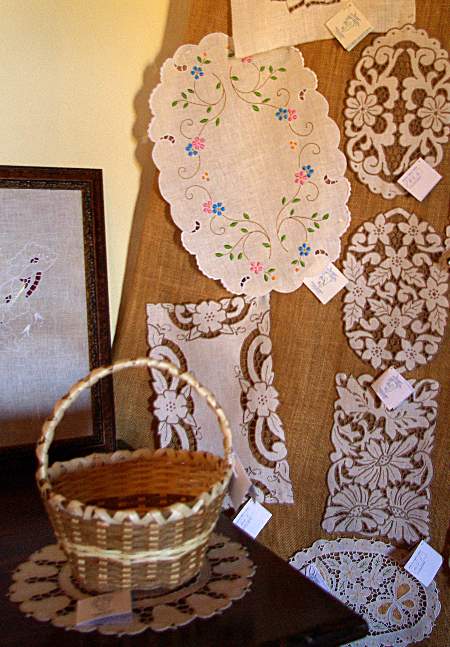
Although the place is small, they've packed a lot in. They've got lots of traditional embroidery and basketwork. They've also got the local cigars, which Winston Churchill enjoyed when he visited in 1959, and ceramics from a local artist.

Some of the fine embroidery and drawn-thread work on sale in San Jose de Breña Baja, La PalmaSome of the fine embroidery and drawn-thread work

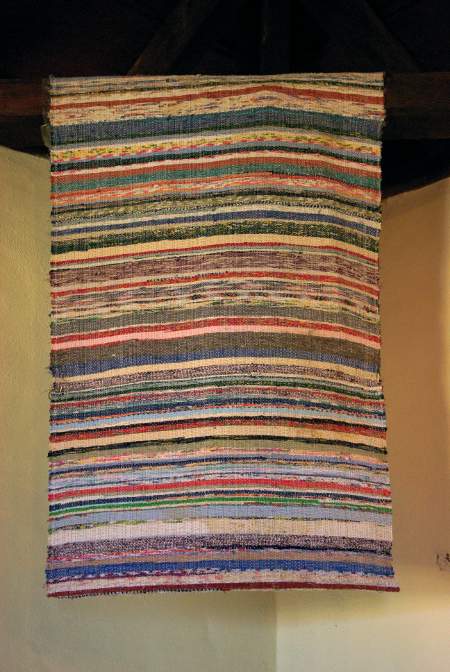
And my personal favourite is the Canarian style rag rugs. Like most places, poorer people needed to make use of everything, and so they made rugs out of old clothes. Here, the cloth to be recycled was torn into narrow strips, which were then sewn together to make longer ones, and finally used as the weft thread on a loom (usually with a linen warp thread).

The shop opens on Tuesday -- Saturday, 4pm -- 8pm

A Canarian-style rag rug on sale in San Jose de Breña Baja, La PalmaA Canarian-style rag rug

Labels: , , , ,

Bookmark with:

Del.icio.us Digg Reddit Facebook Furl It Newsvine StumbleUpon ToolbarStumbleUpon

Monday, 1 February 2010

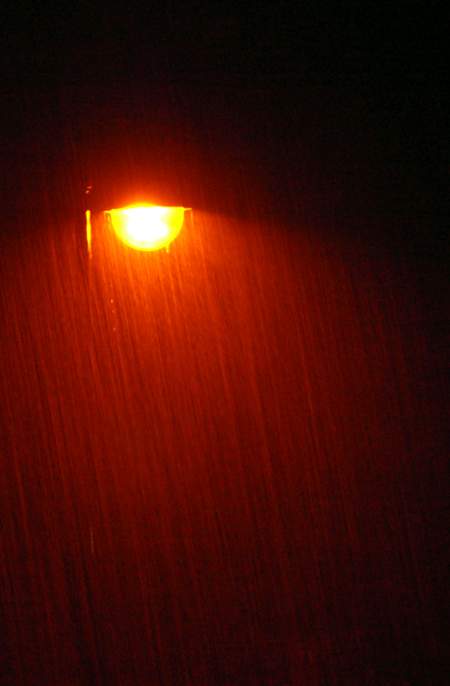
It's Raining on La Palma


Some people think it never rains in La Palma. Well, it's the greenest of the Canary Islands for a very simple reason. And right now, it's busy getting greener. In fact, we have an official orange weather alert, and all school is cancelled for tomorrow, for the whole archipelago.

The thing is, it's not raining all that much, at last not here. It's just like a wet day in Wales.

I suppose it's rather like the way Britain grind to a halt with the sort of snowfall that wouldn't bother a Siberian at all. And of course here, the rain is at last warm.

Labels: , ,

Bookmark with:

Del.icio.us Digg Reddit Facebook Furl It Newsvine StumbleUpon ToolbarStumbleUpon

Wednesday, 27 January 2010

Star Finders

Galaxy M100 taken with the Isaac Newton Telescope and Wide Field Camera by Simon Driver.
M100 (NGC 4321), a barred galaxy in the Virgo cluster

There's a really simple reason why the Royal Greenwich Observatory moved their telescopes here. It's one of the three best places in the world for astronomy.

A modern telescope could see the equivalent of a candle on the moon, so obviously they want to be well away from city lights. Even more obviously, they want to be somewhere that doesn't get many cloudy nights.

Much less obviously, they want to be somewhere the stars don't twinkle. This happens when the air's turbulent. It's pretty, but it really messes up your view.

There are three places in the world which are great on all three counts, and La Palma is one of them. (The other two are the peak of Mauna Kea, Hawaii, and the Atacama Desert in Chile.)

The problem is to keep it that way.

When the observatory moved here, they asked for, and got, an agreement to limit things like street lights. Los Llanos has a street with lamps which remind me of 1950's hairdryers - the sort that go all around your head.

Recently the island government committed to spending over a million euros to update the streetlights to reduce the light pollution even further.

The result of all this is that La Palma is a great place for amateur astronomers, too. Even in a resort, people notice how many more stars you see here, compared to almost any English town or city. Here's another picture, this time of M51, taken by my friends in Franceses with an 80mm amateur telescope on their first night's astronomy since they moved here. Of course there's a lot of skill involved too. But they used to live in Streatham, and no amount of skill would produce that kind of result there.

If you want to recognise the constellations, the best solution is something called a planisphere. This is two special circles of plastic fastened at the centre. Twirl them until the date on one lines up with the time on the other, and you get a picture of the night sky for the right time, date, and position on the planet. (In fact you want to set the time for an hour later than GMT because clocks on La Palma are set just one hour behind Madrid, which leaves us in the same time zone as
London, but a long way west.)

If you bring a UK planisphere with you, everything will be shifted and it won't show the southern stars at all.


Perhaps surprisingly, the best one for the Canaries is titled "Hawaii, Mexico, India, Hong Kong, Taiwan." This is because you have to buy one for the correct latitude (your distance north or south of the equator) but the longitude (east-west distance from London) doesn't matter, because you compensate for that when you set the time.


Amazon.co.uk sells normally sells them for £6.99 (at left), although the last time I looked they only had a used one, (and it was more expensive). If you want a UK planisphere, it's slightly cheaper (at right).


Amazon.com also sell them. The one for La Palma is $13.87 (below)
Philips Planisphere from Amazon.com


Happy stargazing!

Labels: , , , , ,

Bookmark with:

Del.icio.us Digg Reddit Facebook Furl It Newsvine StumbleUpon ToolbarStumbleUpon

Sunday, 24 January 2010

Almond Blosson on La Palma

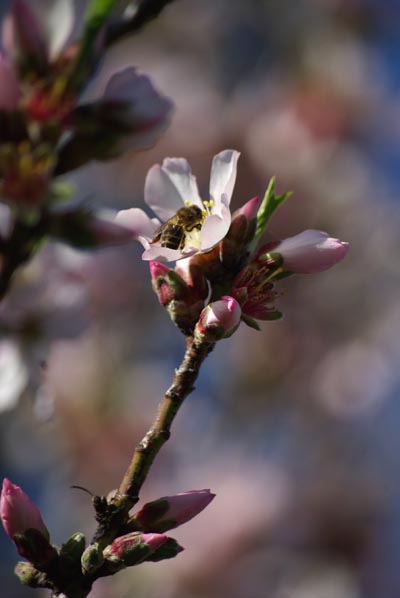
Almond blossom in Garafia, La Palma IslandAlmond blossom in Garafia

The north-west of the island is home to great many almond trees, and at this time of the year, they're all blossoming.

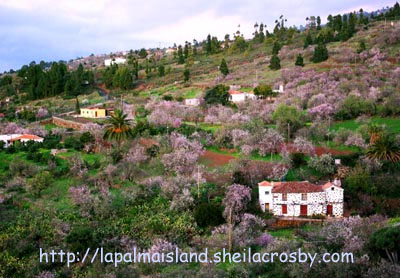
The trees in El Paso and Garafía are beautiful, but the best display of all is at Puntagorda. In fact Puntagorda hosts an annual almond blossom fiesta. The date varies -- the Town Hall sets it a couple of weeks in advance, to (hopefully) coincide with the best blossom.

At noon on Sunday, February 1st, there's the traditional pensioners' almond cracking contest. The winner will be the person who produces the most shelled and unbroken almonds.

On Friday 5th there will be football competitions (for men and women)at 4pm, plus a disco in the community hall at 10 pm followed by and music in the street.

On Saturday 6th at 10 pm there will be a concert and dance in the Community Centre, followed by music and dancing in the street.

The main day is Sunday 7th.

Starting at noon, they'll have bouncy castles in the school playground, and a photo exhibition in the cultural centre (about the delightfully silly Battle of Lepanto fiesta in Barlovento), and dances in the cultural centre, the sports centre, and the street,

I expect they'll have the usual street market, and they'll be giving out free wine and almonds. Be warned that the wine may well have been stored in barrels made of tea (pronounced tay-ah) which gives it a resiny taste. Some people love it. I don't.

The programme is up on the web at http://almendros.puntagorda.es/.

Almond blossom in Puntagorda, La Palma islandAlmond blossom from the Mirador (viewpoint) de Millflores in Puntagorda

Labels: , , , , ,

Bookmark with:

Del.icio.us Digg Reddit Facebook Furl It Newsvine StumbleUpon ToolbarStumbleUpon

Wednesday, 20 January 2010

Rooftop Viewpoints

Traditional roof with a space to view the port of Santa Cruz de la Palma.Traditional roof with a space to view the port.

These days, Santa Cruz de la Palma is a bit of a backwater. But three hundred years ago, it was the third biggest port in the Spanish Empire. Almost every ship traveling from Spain to the Americas stopped here. In the 19th century, it was still a major port, and many of the inhabitants waited anxiously for a ship bringing their merchandise, letters from family members who'd emigrated to Cuba or Venezuela, or the loved ones themselves, as passengers or crew.

Consequently many of the older houses have viewpoints on the roof, like a little crow's nest. They're all designed to give a view of the port, although in some cases the view is now blocked by a tall, new building, like these houses in the Calle Real. They're a nice reminder of the past, and I have fun trying to spot them, even though I can't believe that they get much use in the internet age

Labels: , , , ,

Bookmark with:

Del.icio.us Digg Reddit Facebook Furl It Newsvine StumbleUpon ToolbarStumbleUpon

Saturday, 16 January 2010

Travel Between the Canary Islands

Perhaps surprisingly, flights are not necessarily the fastest way to travel between islands. Certainly they are if you want to go to Santa Cruz de Tenerife: there are 17 flights a day, and they take about 30 minutes.

But if you want to go from one small island to another, say La Palma to El Hierro, then that means two flights. By the time you've checked in, flown to Tenerife, waited for your connection and flown again, it can easily take four hours.

The Armas ferry takes four hours, and it costs €12.50 one way, instead of about €41.70 (and that's a special offer). The catch is there's only one direct ferry a week, on Sunday afternoon.

If you're going to Gomera, it'll take you four hours to fly, and only two on the Fred Olsen ferry or three on the cheaper Armas ferry.

Most inter-island flights to Tenerife go to the north airport (Los Rodeos, TFN) whereas the ferries go to Los Cristianos in the south, which is near the international airport (Reina Sofia, TFS).

Mostly, it boils down to what's going in the right direction at the right time, and whether you want to take a car.

Oh, and for people who suffer from travel sickness, the usual tablets are Biodramine.

Ferries

Fred Olsen Fast (2 1/2 hours) ferry to Los Cristianos in southern Tenerife
Naviera Armas ferries Slower and cheaper. Also the only direct ferry to El Hierro.
Trasmediterranea Ferries to S/C de Tenerife, Las Palmas de Gran Canaria, Arecife and Cadiz

Flights

Binter Canarias Inter-island flights
Islas Airways Inter-island flights (website in Spanish only, but usually a little cheaper)

Labels: , , ,

Bookmark with:

Del.icio.us Digg Reddit Facebook Furl It Newsvine StumbleUpon ToolbarStumbleUpon

Sunday, 20 December 2009

Nativity Scenes


Christmas trees are a newish thing here, although probably most houses have one now. The main traditional decoration is nativity scenes. Some just show the stable, but some public ones are so elaborate that they include the whole village, and it's always a Canarian village. Obviously that's historically inaccurate, but no more so than all the English nativity scenes where Mary and Jesus are blond.

This one was on display in Santa Cruz de la Palma last year.As you can see, it came complete with moving figures and running water. In fact the lights at the back are on a timer, and simulate sunset, night, and morning too. I didn't include that on the video, because it took too long and I didn't think the camera would film the low light levels anyway.

Usually a large nativity scene (belen in Spanish) includes at least one person squatting behind the bushes. If there's one here, I missed it.

They've just opened this years belen in Palacio Salazar, on the Calle Real. It's open from 10 am to 1 pm and 5 pm to 8:30 pm until January 6th.

Labels: , , , , ,

Bookmark with:

Del.icio.us Digg Reddit Facebook Furl It Newsvine StumbleUpon ToolbarStumbleUpon

Saturday, 12 December 2009

The Balconies


These are the famous sea-front balconies in Santa Cruz de la Palma. Actually these are the backs of the houses: the fronts look onto the Calle Real.

When I first came to the island in 1990, the woodwork was all green and the plaster all white. For the town's 500th anniversay, in 1993, the whole lot disappeared behind acres of black plastic sheeting for weeks while they were repainted in the best possible guess at the original colours.

Then on 6th November 1993 they held an unveiling ceremony. The new paint job was quite a surprise.

Santa Cruz does a good job of that sort of thing. We had fireworks, music, people on stilts and the giants who normally only come out for Carnival


The owners of the houses were originally promised that the town hall would repaint the balconies in green and white, but most of them elected to keep the new colours for a while. These days they're a mixture between the two styles. Some people say it looks a mess, but I think it's exactly what you'd expect in real town in a free country, rather than a museum.

They have a narrow pavement in front of them, then there's a wall and another pavement perhaps two feet higher, and a main road. The explanation is simple. The houses and the lower pavement are about 350 years old. The higher pavement and road are much newer. I've seen old photographs where the beach comes right up to the old pavement.

Labels: , , ,

Bookmark with:

Del.icio.us Digg Reddit Facebook Furl It Newsvine StumbleUpon ToolbarStumbleUpon

Wednesday, 9 December 2009

The Tsunami Risk

You may remember the fuss in 2001 when two geologists, Steven Ward and Simon Day, announced their theory that the west side of the island of La Palma would collapse one day, creating a mega-tsunami that would cross the entire Atlantic and still be anything up to 25 metres high when it hit New York, and indeed everything from Newfoundland in Canada to Recife in Brazil.

These days, almost all geologists seem to disagree.

Certainly there is a fault line, and some movement has been detected, but the fault appears to be 4 km long, not 25 km. There is no evidence that it's 2 km deep, so any landslide would be superficial and might not happen all at once. There's a volcano, but it's comparatively small. And there's a lot of water inside the island, but if the volcano erupts and turns it to steam, it has lots and lots of escape routes through the porous lava. Therefore it won't push the rock into a landslide.

The tsunami that did such awful damage in December 2004 was caused by an earthquake along 1,000 km of sea bed. If a landslide does happen on La Palma, it couldn't possibly be longer than 25 km, so the tsunami will weaken as it spreads out. You'd hardly get a splash the other side of the Atlantic.

By the way, the research was paid for by an American insurance company. And it wasn't published in a peer-reviewed journal, which means that other scientists didn't get chance to give opinions before it was broadcast.

My opinion? It's a load of hype.

You can read more at: http://www.lapalma-tsunami.com/tsunami.html
and http://www.iberianature.com/material/megatsunami.html

Labels: , , , ,

Bookmark with:

Del.icio.us Digg Reddit Facebook Furl It Newsvine StumbleUpon ToolbarStumbleUpon

Friday, 13 November 2009

San Martin

Free chestnuts and wine at Mazo Farmer's Market

While most of Europe celebrates Remembrance Day, here it's St. Martin's Day - San Martin. (Spain was officially neutral in both world wars, so they don't have a Remembrance Day).

San Martin is traditionally when the chestnuts are ready to pick, and the new wine from the summer's grape harvest is ready to drink. (Although with global warming, the chestnuts have been in the shops for weeks.) So most families go off to the bodega (wine store) for a wine-and-chestnuts party. The more traditional ones blow conchs.

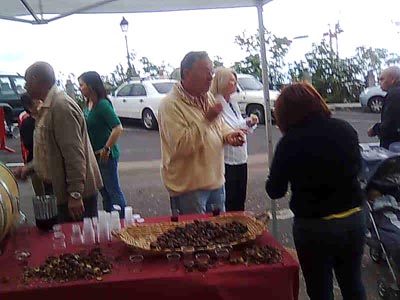
On Saturday they were handing out free wine and roasted chestnuts at Mazo market. Delicious!

Chestnuts

Labels: , , , , , ,

Bookmark with:

Del.icio.us Digg Reddit Facebook Furl It Newsvine StumbleUpon ToolbarStumbleUpon

Friday, 30 October 2009

Dragon trees

Dragon tree at sunset

One of the most exotic looking plants on La Palma are the dragon trees.

The latin name is Dracaena draco Although they grow anything up to 12 metres tall, botanically, dragon trees aren't trees. They don't have annual rings, for one thing. Actually, they're classified in the same order (Asparagales) as garlic and asparagus, although they look nothing like each other. In fact, dragon trees look mostly like broccoli on steroids.

They grow throughout the Canary Islands, and also in Cape Verde, the Azores, Maderia, and western Morocco.

Because they don't have annual rings, it's hard to tell their age. The trunk branches every time they flower, which isn't every year. So you can tell how often a trees has flowered, and make an educated guess at its age that way. The tree in the photo has flowered just twice. The oldest ones seem to be about 650 years old.

The resin is reddish. In ancient Roman times, people used to dry it and sell it to alchemists as dragon blood. It must have fetched a packet.

The Canary Islands used to have a large, flightless bird, something like a Dodo. This bird ate dragon tree fruits, so the seeds evolved to have a hard protective covering to survive the bird's digestive tract. Now that the bird is extinct, this covering makes it had for the seed to germinate. The north of La Palma is one of the few places where the trees are reproducing naturally. In other places they put the seeds in an acid bath for a few hours (much like the inside of a bird) to remove the hard coating before planting the seed.

One of the best places to see them is at Buracas, below the village of Las Tricias in Garafía. That's where I took this photo. There's another lovely group at La Tosca, in Barlovento, which you can see from a viewpoint on the main road from Barlovento village to Gallegos. And there's the famous twin dragon trees in Breña Alta.

Labels: , , , , , , ,

Bookmark with:

Del.icio.us Digg Reddit Facebook Furl It Newsvine StumbleUpon ToolbarStumbleUpon

Friday, 23 October 2009

El Paso's Silk Museum

La Palma has a long history of silk production, going back to the 16th century. In fact, at one time, silk was made in all the Canary Islands, but since the 19th century, El Paso, in the centre of La Palma, is the only place which still produces it.

They use an old fashioned, labour-intensive technique, the only place in Europe which still does so. You can see most of the process at the silk museum in El Paso, where the staff will talk you through the process in Spanish, English or German. The only parts they don't do on the premises are those involving boiling water.

First, you have to care for the silk worms. They eat mulberry leaves, but you can't just leave them on the mulberry tree or the birds will eat them. You have to keep them in a box, and collect leaves for them, and clean the box out. They have silk worms on view at the museum in the spring, but there are none available at this time of year.

Eventually, of course, they make themselves cocoons.

Silk cocoons, El Paso silk museum, La Palma, Canary IslandsSilk cocoons.

If you let the silk moths hatch naturally, they chew through the threads to get out, and you're left with a bunch of short threads, instead of one long one. So they put the cocoons into boiling water, which softens the natural glue holding the cocoon together, and pull out the threads in groups of about 15. Amazingly, you get about 1 km of thread from each cocoon.

Once the threads are out of the water, the glue hardens again, and the sticks the individual threads into one. At that point, it doesn't feel like silk. It's much rougher, something like linen.

The threads are wound onto a drum, with thicker sections separated from thinner ones. From there, they're wound onto bobbins, and then two or three threads are wound together onto another bobbin, to make a thicker thread. (The thickness of the thread depends on what it will be used for. Ties, for example, are generally made of three-ply silk.) These threads are then twisted together by hand, working one section at a time, from the bobbin at the right of the picture to the one at the left.

Spinning silk, El Paso silk museum, La Palma, Canary Islands
Spinning the silk.

Then the silk is wound into skeins again, so that it can be boiled with soap, to remove the natural glue. This gives the silk gets its delightful, soft texture, and allows it to be dyed.


Dyes for silk, El Paso silk museum, La Palma, Canary Islands
Plant dyes and the colours they give to silk.


Only natural dyes are used. Most of them are plants, like eucalyptus leaves, marigold petals, almond shells and onion skins, but cochineal beetles and lichen (Roccella canariensis) are also used.

The silk comes out with beautiful, glowing colours.

Skeins of dyed silk, El Paso silk museum, La Palma, Canary Islands
Skeins of dyed silk.

And then it has to be wound onto bobbins yet again, and finally woven. The museum contains three looms, with the oldest dating from 1860.

All this hard work makes the final product distinctly pricey. A tie costs about 150 € and a scarf costs about 210 €, and both are on sale in the shop, along with smaller, cheaper items.

The museum is in the centre of El Paso, Calle Manuel Taño 6
Opening hours: Monday – Friday, 10 a.m. – 1 p.m., also Tuesday and Thursday, 5 p.m. to 7 p.m.
Entrance fee: 2.50 €

Weaving silk, El Paso silk museum, La Palma, Canary IslandsWinding silk onto bobbins and weaving silk.

Labels: , , , ,

Bookmark with:

Del.icio.us Digg Reddit Facebook Furl It Newsvine StumbleUpon ToolbarStumbleUpon

Friday, 16 October 2009

The Molino Museum

Old weights at the windmill museum, Mazo.
A collection of old weights

As well as the workshop making replica ceramics, the windmill at Mazo houses a small museum. Entry is free, but there are a couple of places you can make a donation. Upstairs is mostly a collection of old tools: an old Singer sewing machine, combs for flax, knife grinders, braziers...

Old oil lamps at the windmill museum, Mazo.
Oil lamps

... the millers glasses, shepherd's poles, long handled pallets for putting bread in a large oven. To be honest, it's all crammed in rather haphazardly, but it's almost all labelled, and it's rather fun.

Gears underneath the windmill, Mazo.

But the best bit is downstairs. Much of the bottom of the windmill is still there. You can see the main flywheel and the gears, and hoppers for the grain.

Gears underneath the windmill, Mazo.

Best of all, you can still turn some of the mechanism by hand. Of course young boys love this.

Gears underneath the windmill, Mazo.
The brake and the bread kneader

Labels: , , , , , ,

Bookmark with:

Del.icio.us Digg Reddit Facebook Furl It Newsvine StumbleUpon ToolbarStumbleUpon