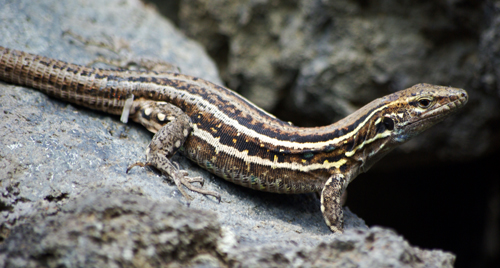
Geckoes

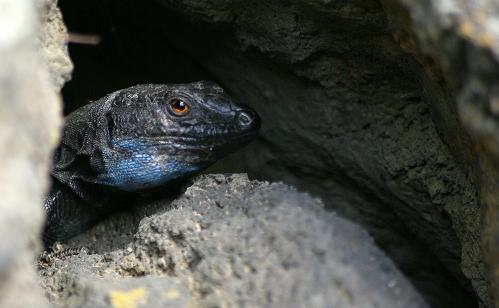
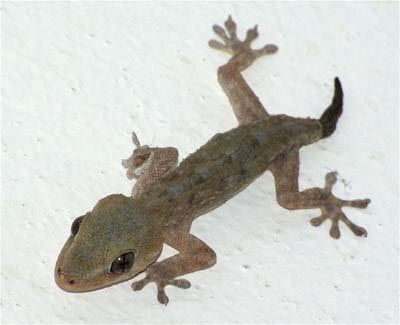
This is a gecko. They like to live in warm buildings or on sunny walls outside, and this one lives in my house. I think he must have got too close to one of my cats because his tail's regrowing. You see, if they're in serious danger of being eaten, their tails come off and provide a wriggling decoy while the gecko runs away.
He spent most of yesterday on this smooth vertical wall. They can walk across ceilings too, like Spiderman. I think he might have been asleep, since he never moved, although it's hard to tell because they don't have eyelids. I rather like to have him around, because they eat insects, including mosquitoes. When they hunt, they stalk the insect slowly until they get close enough, then the tongue flicks out and grabs the unfortunate bug, and that's that.
The really surprising thing about them is their call. It sounds like the chuckle of a mad axe-murderer, which is quite alarming when you're alone in the house and you haven't a clue what it is.
Labels: Canaries, Canary islands, La Palma, Wildlife
Bookmark with:
Del.icio.us
|
Digg
|
Reddit
|
Facebook
|
Furl It
|
Newsvine
|
|
| "Walk! La Palma" is a good book, but the bit about the bottom end of the walk at Cubo de la Galga is out of date already. The Island Government (the Cabildo) have been busy. |

There is now a car park at the beginning of the walk, on the road at km 16. You're unlikely to get lost for the first kilometre or so, because the path's actually asphalted, never mind signposted. It's a matter of taste, but this part was a bit too tamed for my taste, and I was glad when the asphalt stopped. In fact the path is currently so smooth you could actually walk for a couple of kilometers in stilettos, if stilettos are your thing. (I bought a pair of stilettos just before I came to La Palma. I've used them so little that seventeen years later, they still don't even need heeling.)

There are caves in the ravine walls. This one has a wall built across the mouth. at the time we wondered whether people had lived there at one time. Now I wonder whether it mightn't be the "windows" in the water channel, the Canal de Estado.

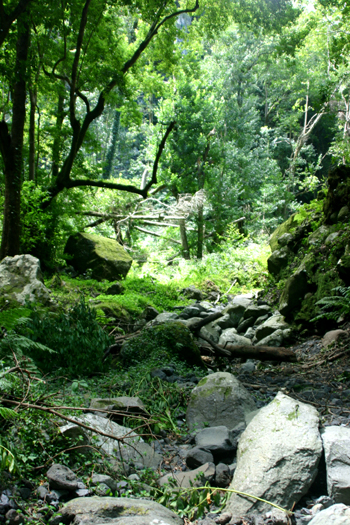
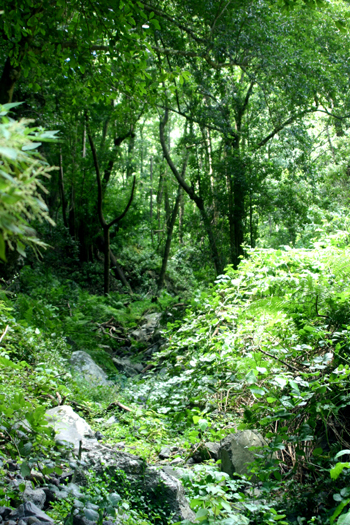
The book is absolutely right that the place would be famous if it weren't so close to Los Tilos. The path criss-crosses the stream bed (a trickle in April) and the ravine walls and trees tower over you.

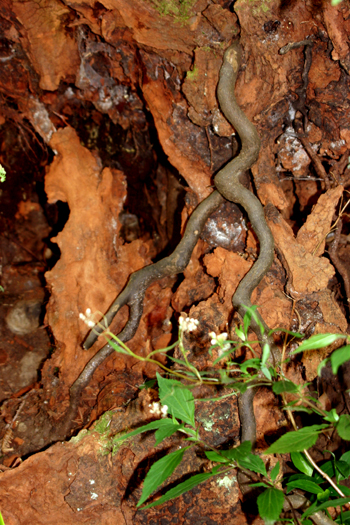
This means that the roots are at eye-level.

When the signpost seemed to indicate that it was time to turn back, we carried on a little, up a much rougher path.

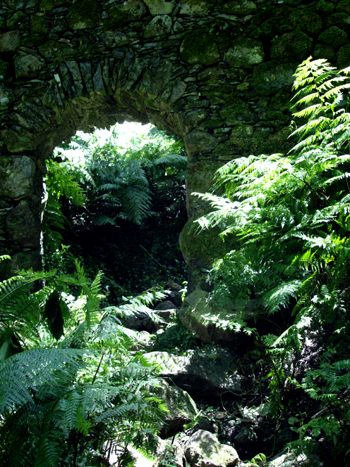
The path went under a little aqueduct.

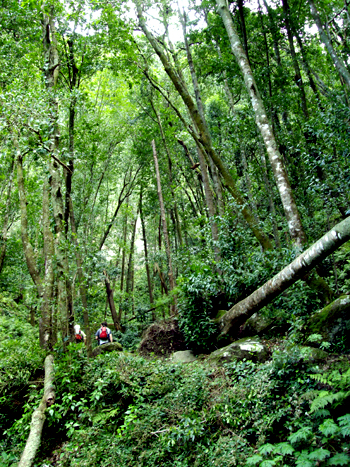
Just above there is a flattish space, where we stopped to eat our sandwiches. Above that, the path divides. According to Charles Davis, you can make your way back to the road by another route, but we weren't sure of the way and I had to get back for the babysitter. So I can't tell you whether there are still fallen trees over the track.

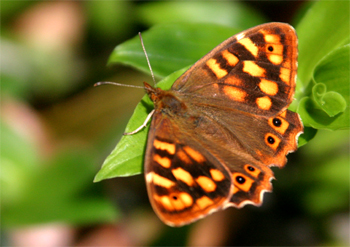
Throughout the walk, there were lots of butterflies, mostly sitting still until the camera focused, and then fluttering off. But I got lucky eventually. This one is common in the western Canaries, but lives nowhere else.

Maculada de Canarias butterfly, Pararge xiphioides
Labels: Canaries, Canary islands, cubo de la Galga, hiking, La Palma, puntallana, walking, Wildlife
Bookmark with:
Del.icio.us
|
Digg
|
Reddit
|
Facebook
|
Furl It
|
Newsvine
|
|
Del.icio.us
|
Digg
|
Reddit
|
Facebook
|
Furl It
|
Newsvine
|
|
Del.icio.us
|
Digg
|
Reddit
|
Facebook
|
Furl It
|
Newsvine
|
|
Del.icio.us
|
Digg
|
Reddit
|
Facebook
|
Furl It
|
Newsvine
|
|

Del.icio.us
Digg
Reddit
Facebook
Furl It
Newsvine